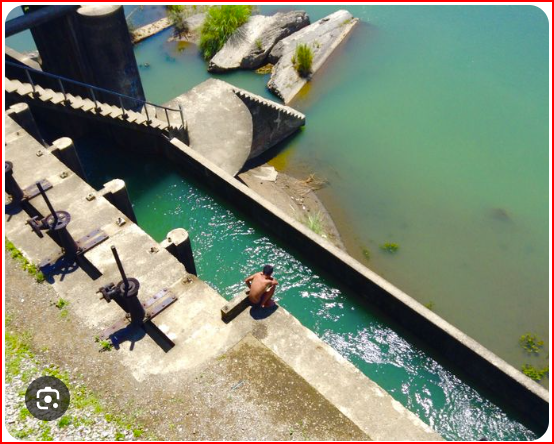
A lot of people are now visiting Vintar Dam, including me, because it is now designated as a tourist attraction by the municipal government. At the same time, a lot of people are wondering why it is called a Dam, when all it has is an irrigation water catchment build on a hilly bank that irrigates the rice fields of Vintar, Bacarra and Laoag. So, what is the deal here?
Vintar Dam & Irrigation
What really happened to the Vintar Dam?
Luz Duque · San Roque
Community answers
This is a news article from August 6, 1927, published on page 7 of the Graphic, titled "THE LAOAG-VINTAR DAM TRAGEDY" written by the Editor (https://philippinesgraphic.com.ph/). It details the history, construction, and catastrophic failure of the Laoag-Vintar irrigation dam project in Ilocos Norte, Philippines.
Here is the complete, readable transcription of the article text presented as a single continuous piece:
Where Do We Come In?
But the Vintar farmers were not so altruistic as that and asked, "It is all very well, but where do we come in?"
At which the explanation came: "You will come in this way. Your unirrigated fields will forever re-enjoy a steady irrigation which ought to treble your crops. There will be water up to everybody's neck. Even your old fields which are now irrigated will not be so ungrateful as not to produce more rice and more corn. There will be enough crop to make everybody rich."
It sounded well. There will no longer be that annual rebuilding of the rock dams and the annual digging of the muddy ditches. Henceforth, these poor farmers will be able to contemplate with pleasure both rain and shine, whereas before, to them, rain meant the blowing off of their rock irrigation makeshifts and shine, the parching of their unemic rice plants in their unirrigated areas. Henceforth or, at least, when the great, big dam is finished, nobody will give a darn. The annual song will be:
Let 'er rain,
Let 'er shine,
Let 'er storm,
Let 'er parch 'em
But she can't parch us no more!
Everybody Happy
One day in 1924, immediately after the dry season set in, the farmers of Vintar and Bacarra set out for a very pleasant job—something next to their heart. The old rock makeshifts were leveled down and the old ditches closed. And they destroyed them and closed them with a feeling of pleasant relief. We can be sure that they did all these with a smile on their lips.
Soon, the big dam began to rise and everyday farmers of the locality were getting happier and happier, not only because of the pleasant expectation of bigger crops in the future but also because they could work as laborers on the rising dam and get ready cash from the government. All was well, indeed!
The rice planting season set in. The dam was almost completed. Water, and plenty of it, was already surging into the vast rice areas of the three municipalities. All available areas were planted to rice. There was water up to everybody's neck, indeed, and young rice plants in the vigor of their youth were seen in that early season actually trying to crowd out the bamboo and the mango trees from the nearby hills.
And the simple farmers, seeing this unmistakable omen of prosperity, dreamed dreams before they went to bed and woke up with a smile on their lips.
But then, they did not know the half of it!
Good-Bye Dam!
One week early in August, the rain began to pour in earnest. It poured in buckets and it rained cats and dogs. But the farmers still dreamed dreams before they went to sleep and slept soundly once they got under their blankets. There were no more rock dams to build after the rain and they should worry.
One night, after two weeks of continuous rain and when the farmers were soundly sleeping and the rain actually coming down in torrents, a great sound was heard all over the country side. One half of the big dam gave way and with it the farmer's predicted prosperity. There was panic, consternation, desolation.
A lull in the rainy season began. The rice fields also began to dry up and the rice plants started to wither. Not only was there practically no crop that year but about a hundred hectares of the Vintar area was turned by the deviated stream into a bed of rocks. With half of the dam blocking the flow of the angry stream, the river naturally jumped off its course and wrought havoc where it passed. And it passed over some of the richest rice fields in the municipality.
That year, all the rice plants that lived up to harvest time in Vintar and Bacarra, lived on the...bountiful rains of the upper region, but even these only yielded enough for immediate consumption.
But the same tragedy was enacted just when the young rice plants were again heralding a heavy crop and plenty of cash for all. And to boot, some more fertile areas were either washed out to sea or turned into rocky beds by the raging stream.
If you want to know more, see here: http://www.vintar.com
Source / reference: Philippinesgraphic.com · Open source
The flood control projects scandal in the Philippines recently that involves allegations of corruption, mismanagement, and irregularities in government-funded flood control projects jog my memory of what my grandfather's story of the collapse of the Vintar Dam.
According to him, contrary to popular beliefs, the Americans were never involved in the planning and construction of the Dam.
It was a project initiated and planned by the Bureau of Public Works. He claims that the incident was a failure of institutional design and planning oversight within the Bureau of Public Works itself rather than a single individual's fault.
He believes that like today, it was a scandalous waste of public funding. He pointed out that they spend over ₱270,000 which is roughly about ₱25 million to ₱30 million today. He highlighted how the Bureau of Public Works repeatedly altered construction blueprints after initial flood damage, only to have the structure wash away a second time. The Dam was completely demolished by seasonal floods in August 1926.
Source / reference: Ni LoLo Artemio Mabanag
Add what you know
Personal recollections are welcome. If you have a document, book, article, archive, or other reference, identify it so readers can distinguish memory from documented evidence.